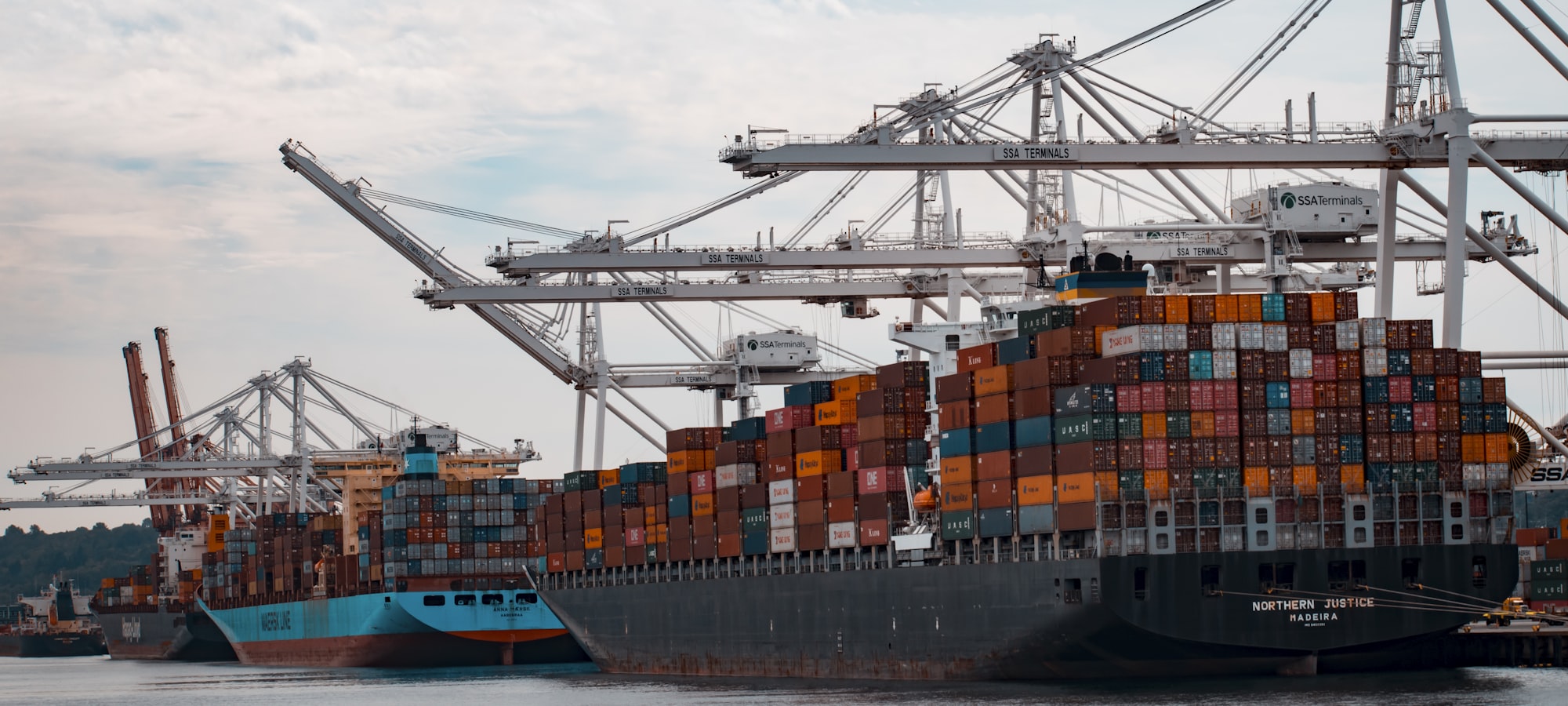
Sea freight from Frankfurt.
Pre-carriage included.
Frankfurt has no port, but Rotterdam, Antwerp, Bremerhaven and Hamburg connect through established road corridors. The pre-carriage is coordinated by the same dispatch that moves your road freight.
The container is the easy part.
With sea freight it is rarely the ocean leg that decides whether it goes well. It is what happens at both ends: pre-carriage to the port, terminal handling, customs, onward delivery. That is exactly where we sit — with a road dispatch that already runs to the North Sea ports regularly.
The first decision is FCL or LCL. A full container is yours alone and travels sealed; a consolidated container shares the space and is packed and unpacked at a CFS at both ends. From roughly thirteen to fifteen cubic metres your own container usually pays — below that, rarely.
About 33 and 67 cubic metres. Payload on a 40-foot container is roughly 26 to 28 tonnes, also limited by road law on the pre- and on-carriage.
About 76 cubic metres at the same payload. The standard choice for volume freight that does not reach the weight limit.
Temperature control, over-height and out-of-gauge. These need more lead time, a confirmed booking and often a permit for the road legs.
Charged per w/m: one cubic metre or one tonne, whichever is greater. For anything below a sensible full container.
Four things that make sea freight expensive.
None of them is exotic. They only cost money when nobody talked about them first.
VGM is mandatory
Under the SOLAS rules the verified gross mass of the packed container must be filed before loading. No VGM, no loading. We file it — the figures have to come from you.
Demurrage and detention
After arrival there are free days; beyond them the carrier charges daily — demurrage while your container sits in the terminal, detention while you hold it outside. How many free days apply is stated in the quotation.
Transit times are indicative
Far East to Northern Europe runs roughly thirty to forty days port to port depending on the service. Transhipments, blank sailings and port congestion move that. So we name the service, not just a number.
Customs is part of the plan
Import and export clearance, T1 transit, and who owes what under the agreed Incoterm. We settle that before the booking — not once the container is standing in the port.
How it is priced
FCL is priced per container, LCL per w/m — one cubic metre or one tonne, whichever is greater. On top come terminal handling at both ends, the security surcharge, documentation and, depending on the trade, fuel and currency surcharges. Road pre- and on-carriage are shown separately.
Ocean rates move sharply and are adjusted by the carriers at short notice. A quotation therefore always names its validity period and the service it is based on.
What we need to quote it
Volume and weight decide whether FCL or LCL is cheaper. Without both, the question cannot be answered.
- Origin and destination — port or full address, depending on the scope of service
- FCL or LCL; for FCL the container type and how many
- For LCL: number of pieces, dimensions, volume in cubic metres and weight
- Description of goods and their value
- Dangerous goods under IMDG, with UN number and class
- Incoterm, and whether we handle import or export clearance
- Ready date, and whether a fixed sailing matters
What people actually ask.
As a rule of thumb from about thirteen to fifteen cubic metres, depending on the lane and the current rate level. Below that a consolidated container is usually cheaper; above it your own is — and it is also faster, because the packing and unpacking at a CFS falls away. We price both and put them side by side.
The verified gross mass of the packed container, mandatory before loading under the SOLAS rules. Without it the container stays where it is. We file it with the carrier, but the weight has to come from you — either weighed or calculated by the approved method.
Two separate clocks. Demurrage runs while your container sits in the terminal after the free days expire; detention runs while you hold it outside the terminal and have not returned it. Both are charged daily and get expensive quickly. The free days are stated in the quotation so you can plan.
Roughly thirty to forty days port to port depending on the service, plus pre-carriage, on-carriage and customs. Direct services beat those with a transhipment. We name the actual service and its sailings rather than quoting an average.
Yes — it is the part we do best. Rotterdam, Antwerp, Bremerhaven and Hamburg are integrated into our road dispatch. That gives you one contact for the whole chain instead of separate firms at every handover.
It depends on the agreed Incoterm, which is exactly why we ask for it early. Import and export clearance and T1 transit are arranged through a customs agent. If no Incoterm has been agreed yet, we propose one that suits the shipment.
When to buy something else
Sea freight is unbeatable per kilogram, and slow. These are the cases where that is not enough.