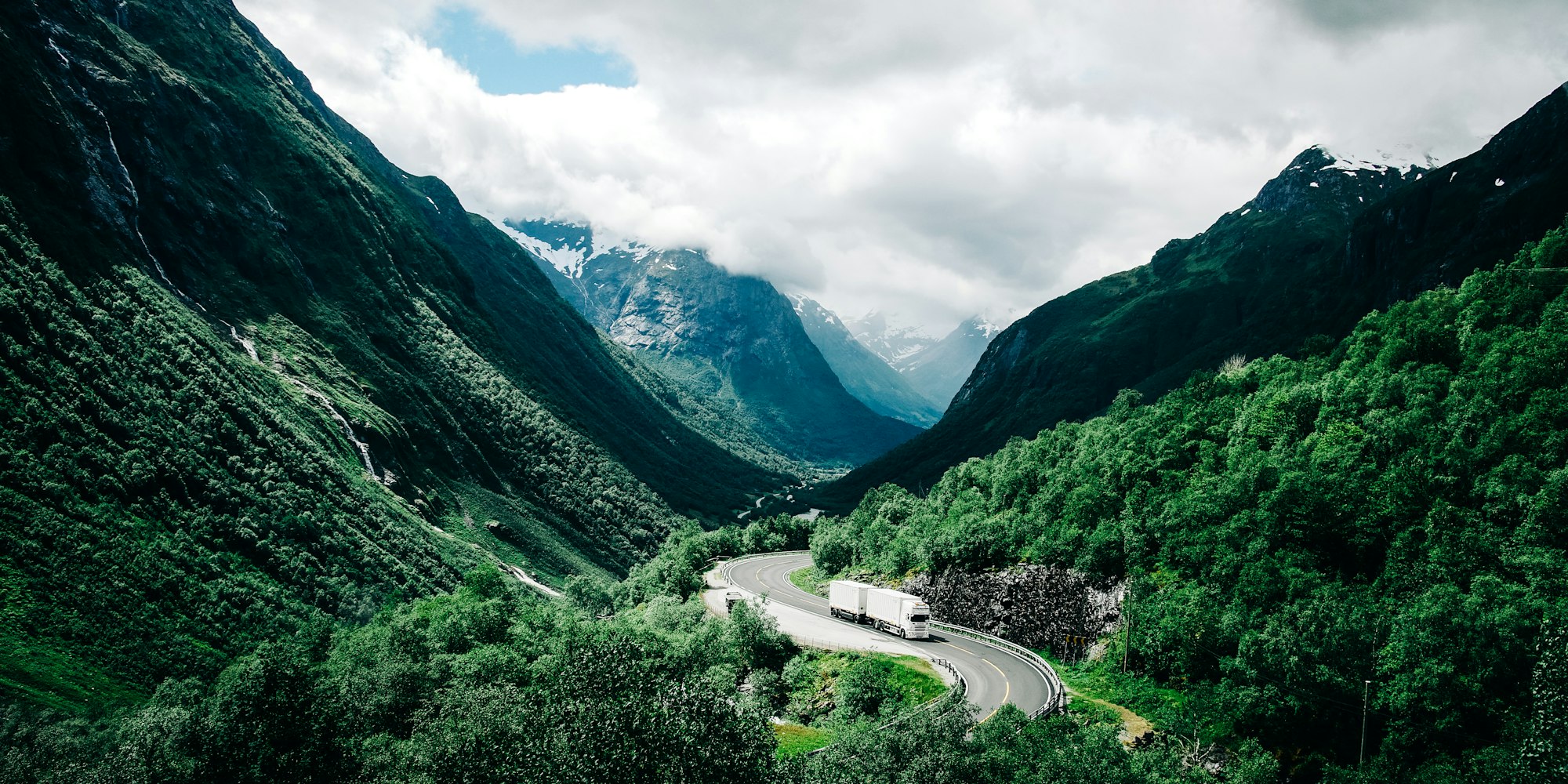
Road freight from Frankfurt.
Full truckload (FTL) and part load (LTL).
The whole trailer when the freight fills it or cannot take transhipment — only the loading metres when it does not. Up to 24 tonnes and 33 europallets, across Germany and Europe.
The whole truck, or shared space.
With a full truckload (FTL) the trailer is booked for you. No other freight travels on it, it does not call at a depot, and nothing is handled between the two docks. That matters for anything fragile, high-value, awkward or on a deadline — every transhipment is a chance for damage and a day of delay.
With a part load (LTL) you pay only for the loading metres you occupy. The market separates two things here: groupage runs via depots and is consolidated there — cheap and predictable, but handled more than once. A part load runs direct with no depot and costs more. Around fourteen pallets the two converge with a full truck, and above that your own trailer is usually the better buy. We price both and put the numbers side by side.
13.6 m loading length, 33 europallets, up to 24 t payload, 2.70 m internal height. Loads from the side, the rear or the top.
3.00 m internal height for volume freight up to roughly 100 m³. Same 24 t limit — you gain space, not payload.
One to fourteen europallets, up to about 7 loading metres and 12 t. Charged on loading metres and gross weight, whichever is greater.
Box body, coil bed, tail lift, moffett, temperature control, ADR. Specified on the transport order and confirmed before collection.
What suits your shipment.
Three products, one question: how much space do you need, and how much time do you have?
Full truckload (FTL)
From about fourteen pallets, when a fixed delivery hour matters, or when the freight cannot be handled at a depot. Dock to dock, no depot, no extra handling.
Part load (LTL)
One to fourteen pallets, driven direct with no depot. Faster and gentler than groupage, cheaper than your own truck.
Groupage
The cheapest option. Runs via one or two depots, takes one to three days longer and is handled more than once — but costs considerably less.
Lead time
In Germany usually collection the next working day, often the same day for requests before 11:00. Specialist equipment needs two to three days.
How it is priced
A full truck is priced per trip — the cost is the same whether you fill the trailer or leave half of it empty. What moves the number is the corridor, the equipment, the time windows, and how likely the truck is to find a load on the way back.
Part load and groupage are priced on loading metres and gross weight, whichever costs more. A europallet is about 0.4 loading metres. Non-stackable freight takes its full footprint even when it is only half a metre tall — declare it up front, it changes the price.
Waiting time beyond the agreed free period, additional stops and out-of-hours delivery appear on the transport order before collection. Nothing arrives on the invoice that you have not already seen.
What we need to quote it
These get you a firm price rather than a range — and the comparison between full truck and part load along with it.
- Loading and unloading postcodes — not just the city
- Pallet count and type, or dimensions and weight if it is not palletised
- Gross weight and height per pallet, and whether it is stackable
- Loading equipment at both ends: ramp, forklift, or does it need a tail lift
- The date it is ready, and any fixed delivery window
- Dangerous goods, if any: UN number, class and packing group
What people actually ask.
Around ten to fourteen pallets, part load and full truck converge on price. Below that a part load is cheaper; above it your own truck is — and it is also faster, because there is no depot in between. We price both before recommending either.
Groupage runs via depots and is consolidated there with other freight — cheaper, but one or two extra handlings and a day longer. A part load runs direct with no depot, costs more and is gentler on the goods. We quote both prices so you decide.
For standard corridors inside Germany, the day before is usually enough. For mega trailers, coil beds and anything cross-border into the Alps, give us two to three days — that equipment is thinner on the ground and the good carriers are booked first.
On a full truckload yes, and that is one of its advantages. On part load and groupage rarely, and we will not promise it — the freight travels with other people's consignments and other people's windows. If a fixed hour matters, that is a full truck or an express run.
Carriage runs under CMR and our transport orders under ADSp 2017, so the standard limit is 8.33 SDR per kilogram of gross weight. If your freight is worth more than that per kilo — and machinery and electronics usually are — say so before collection and we will arrange cargo insurance for its actual value.
Wrapped or strapped so the load and the pallet move as one object. Nothing overhanging the footprint, weight low and centred, labelled on at least two sides. Groupage is handled at least twice — overhang is what gets caught.
Yes, and most customers do. Load securing remains a legal requirement, so the securing method is agreed in writing with the carrier beforehand. The driver can refuse an unsecured load — better that happens at your dock than on a motorway.
Inside the EU there is nothing to declare. For Switzerland, the United Kingdom and Norway we work with a customs agent and the paperwork is arranged before collection rather than discovered at the border.
When to buy something else
Within Europe the truck is almost always right. These are the cases where it is not.